


In vivo CAR-T therapy using lipid nanoparticles (LNPs) is emerging as one of the most promising non-viral approaches to next-generation immunotherapy. By enabling direct immune cell reprogramming inside the patient’s body, this strategy challenges the traditional ex vivo model that has defined CAR-T treatments for over a decade.
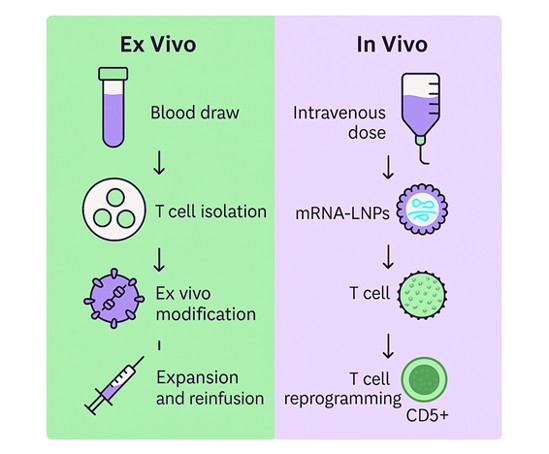
Conventional CAR-T therapy requires harvesting a patient’s T cells, genetically modifying them using viral vectors, expanding them in specialized facilities, and reinfusing them weeks later. While clinically effective in certain hematological cancers, this process remains expensive, complex, and difficult to scale.
In contrast, in vivo CAR-T therapy leverages messenger RNA (mRNA) delivered via lipid nanoparticles to transiently instruct immune cells to express chimeric antigen receptors (CARs). Instead of permanently altering cells outside the body, this approach programs them directly in situ.
Lipid nanoparticles serve as a clinically validated mRNA delivery platform, protecting the genetic payload, facilitating cellular uptake, and enabling targeted immune engineering without the need for viral vectors. This non-viral delivery system has the potential to:
- Reduce manufacturing complexity
- Shorten treatment timelines
- Improve scalability
- Expand access beyond specialized cancer centers
Importantly, the transient nature of mRNA expression introduces an intrinsic safety advantage. Temporary CAR expression reduces long-term toxicity risks and makes this strategy particularly attractive for non-oncology applications such as fibrosis, autoimmune diseases, and infectious disorders, where controlled immune activation is essential.
In this article, we explore how lipid nanoparticles enable in vivo CAR-T therapy, review recent scientific advances, examine key technical and manufacturing challenges, and discuss the future of non-viral immune cell engineering.
What is CAR-T Cell Therapy?
Chimeric Antigen Receptor (CAR) T cell therapy is a form of immunotherapy that enables a patient’s own T cells to recognize and eliminate diseased cells, most commonly cancer cells. This is achieved by genetically engineering T cells to express synthetic receptors (CARs) that bind specific antigens on the surface of target cells.
In the conventional ex vivo model, T cells are collected from the patient’s blood and genetically modified using viral vectors to introduce the CAR gene. The engineered cells are then expanded in specialized manufacturing facilities before being reinfused into the patient. While this approach has demonstrated significant clinical success in hematological malignancies such as B-cell acute lymphoblastic leukemia and diffuse large B-cell lymphoma, it remains complex and resource-intensive.
Key limitations include the high cost of individualized manufacturing, lengthy production timelines, scalability challenges, and the risk of severe adverse events such as cytokine release syndrome (CRS) and neurotoxicity. These constraints have driven interest in alternative immune engineering strategies, including non-viral and in vivo approaches to CAR-T delivery.
Why Go In Vivo?
In vivo CAR-T therapy represents a shift from cell-based manufacturing to direct immune reprogramming inside the patient’s body. Rather than extracting and modifying T cells ex vivo, this strategy delivers messenger RNA (mRNA) encoding the CAR construct using lipid nanoparticles (LNPs), a clinically validated non-viral delivery platform.
Following intravenous administration, LNPs protect the mRNA payload and facilitate uptake by immune cells, enabling transient CAR expression directly in circulation. This streamlined model offers several potential advantages:
- Elimination of ex vivo processing: Reduces reliance on specialized manufacturing infrastructure and personalized cell expansion.
- Lower manufacturing complexity: Simplifies production workflows and may improve scalability.
- Transient CAR expression: Provides temporal control over immune activation, potentially reducing long-term toxicity.
- Redosing potential and broader access: Allows repeat administration and may expand availability beyond highly specialized treatment centers.
Together, in vivo CAR-T therapy offers a more flexible and scalable framework for non-viral immune modulation, with potential applications extending beyond oncology into autoimmune, fibrotic, and infectious diseases.
The Role of Lipid Nanoparticles (LNPs)
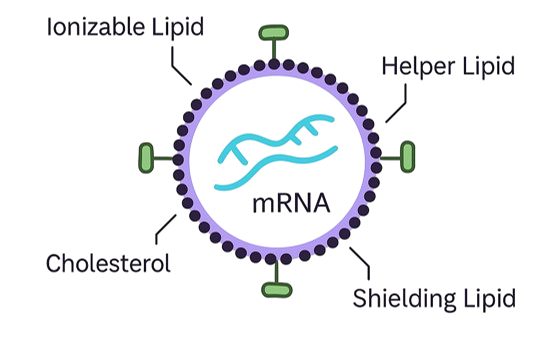
Lipid nanoparticles are the enabling technology behind in vivo CAR-T therapy, serving as a non-viral mRNA delivery platform for direct immune cell reprogramming. These nanoscale carriers protect mRNA from enzymatic degradation, facilitate cellular uptake, and promote endosomal escape, allowing translation of the CAR construct in the cytoplasm.
LNPs are typically composed of four key components: ionizable lipids, cholesterol, phospholipids, and PEG-lipids (or alternative shielding lipids). The ionizable lipid plays a critical role in intracellular delivery, becoming positively charged within acidic endosomes to promote membrane destabilization and efficient mRNA release.
To enhance cell specificity, LNPs can be functionalized with antibody fragments targeting T cell surface markers such as CD3, CD5, or CD7. These antibody-conjugated LNPs (Ab-LNPs) enable selective delivery to circulating T cells, supporting controlled and efficient CAR expression in vivo. Further optimization of lipid structure, formulation parameters, and shielding density can reduce off-target biodistribution, improve immune cell targeting, and limit hepatic accumulation.
By integrating rational mRNA design with targeted nanoparticle engineering, LNPs provide a modular and tunable platform for scalable, non-viral immune engineering.
Recent Breakthroughs in In Vivo CAR-T
Recent preclinical studies have strengthened the case for non-viral in vivo CAR-T approaches enabled by lipid nanoparticles. In a 2025 study, researchers delivered mRNA encoding an anti-FAP CAR using CD5-targeted LNPs in a mouse model. This strategy generated functional CAR T cells directly in vivo, selectively depleting fibrogenic hepatic stellate cells and significantly reducing liver fibrosis in metabolic dysfunction-associated steatohepatitis (MASH).
Other groups have developed modular, antibody-directed LNP platforms optimized for extrahepatic immune cell targeting. These antibody-conjugated LNPs (Ab-LNPs) successfully transfected circulating T cells with CAR mRNA, producing functional CAR T cells capable of B-cell depletion while maintaining transient and tunable activity. Importantly, refined LNP chemistry enabled improved biodistribution and reduced liver accumulation, addressing one of the key challenges of systemic mRNA delivery.
Collectively, these advances demonstrate the feasibility of generating CAR T cells in vivo using mRNA-LNP technology and expand the therapeutic horizon beyond oncology to include fibrosis, autoimmune disorders, and chronic inflammatory diseases.
Mechanism of Action: How In Vivo CAR-T Works
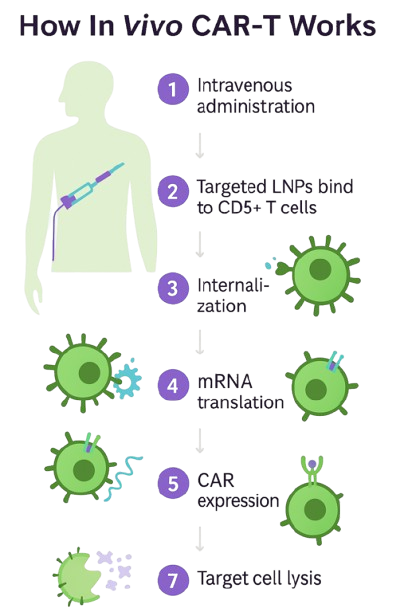
In vivo CAR-T therapy relies on a coordinated sequence of molecular delivery and immune activation steps:
- Formulation: mRNA encoding the desired CAR construct is encapsulated within lipid nanoparticles.
- Targeting: LNPs are surface-modified (e.g., antibody-functionalized) to direct delivery toward T cell markers such as CD3 or CD5.
- Administration: The formulation is administered systemically, typically via intravenous injection.
- Cellular uptake: Targeted LNPs bind to T cells and are internalized through endocytosis.
- Endosomal escape: Ionizable lipids become positively charged in the acidic endosome, facilitating membrane destabilization and mRNA release.
- Translation: Host ribosomes translate the mRNA, resulting in transient CAR expression on the T cell surface.
- Effector function: CAR-expressing T cells recognize and eliminate antigen-positive target cells.
Because the delivered mRNA does not integrate into the genome, CAR expression remains temporary. This transient expression profile enhances safety, enables dosing control, and supports repeat administration strategies.
Therapeutic Applications Beyond Cancer
Although CAR-T therapy was originally developed for oncology, the flexibility, modularity, and transient safety profile of in vivo CAR-T significantly expand its potential beyond cancer indications.
- Fibrosis: In vivo–generated anti-FAP CAR T cells have demonstrated efficacy in preclinical models of liver fibrosis (MASH), selectively depleting fibrogenic hepatic stellate cells and reducing pathological scarring. This approach may be adaptable to other fibrotic conditions, including cardiac and pulmonary fibrosis.
- Autoimmune diseases: Transient CAR T cells could selectively eliminate autoreactive B or T cell populations in diseases such as systemic lupus erythematosus or multiple sclerosis, offering targeted immune reset without prolonged immunosuppression.
- Infectious diseases: CAR constructs may be engineered to target infected cells, including HIV-infected T cells, enabling controlled depletion of viral reservoirs while preserving long-term immune integrity.
- Solid tumors: While delivery and tumor microenvironment barriers remain challenging, optimized LNP targeting strategies and improved biodistribution profiles may enable in vivo CAR-T approaches for epithelial and extra-hematological malignancies.
The modular and tunable nature of mRNA-LNP delivery positions in vivo CAR-T as a versatile immune modulation platform, particularly in indications where conventional ex vivo CAR-T is logistically impractical or carries excessive risk.
Scientific and Technical Challenges
Despite its promise, in vivo CAR-T therapy must overcome several scientific and translational hurdles before widespread clinical adoption:
Targeting precision:
Selective delivery of mRNA-LNPs to T cells is essential. Antibody-directed LNP strategies (e.g., CD3- or CD5-targeted systems) show strong potential, but minimizing off-target biodistribution remains a priority.
Efficient endosomal escape:
Successful intracellular delivery depends on effective endosomal escape, often a rate-limiting step. Ionizable lipid chemistry continues to be a major area of optimization to improve cytoplasmic release efficiency.
Formulation robustness:
mRNA and LNPs are sensitive to degradation and environmental stress. Scalable manufacturing requires controlled formulation parameters, validated stability profiles, and batch-to-batch consistency.
Innate immune activation:
Unintended immune sensing of exogenous RNA or nanoparticle components can reduce efficacy or increase inflammation. Ongoing research focuses on reducing immunogenicity while maintaining repeat dosing capability.
Dosing strategy and pharmacodynamics:
While transient mRNA expression enhances safety, it may necessitate repeat administration. Achieving the right balance between durability, tolerability, and therapeutic effect remains a key clinical development consideration.
Addressing these challenges will be critical to translating in vivo CAR-T from preclinical validation to human clinical trials.
Regulatory and Safety Considerations
The regulatory pathway for in vivo CAR-T therapy will build upon established frameworks for both cell therapy and mRNA-based medicines.
- Non-integrating genetic material: Unlike viral vectors, mRNA does not integrate into the host genome, simplifying long-term genotoxicity concerns and potentially improving the safety profile in non-oncology indications.
- Comprehensive product characterization: Regulatory agencies will require detailed characterization of LNP composition, particle size distribution, encapsulation efficiency, purity, and mRNA integrity, alongside validated process controls ensuring manufacturing consistency.
- Immune monitoring and pharmacovigilance: Clinical development must include careful assessment of acute immune activation, cytokine responses, organ toxicity, and CAR expression kinetics, particularly in repeat-dose regimens.
- Regulatory precedent from mRNA platforms: The rapid global deployment of mRNA vaccines has established regulatory familiarity with LNP-based delivery systems, potentially facilitating early-phase clinical evaluation of in vivo CAR-T strategies.
- Risk mitigation strategies: Early clinical trials will likely adopt conservative dose escalation and intensive monitoring to manage risks such as cytokine release, systemic inflammation, and off-target immune activation.
Together, these regulatory considerations underscore both the complexity and the accelerating maturity of the mRNA-LNP therapeutic landscape.
Manufacturing and CMC Development
For in vivo CAR-T therapies to transition from preclinical innovation to clinical reality, robust manufacturing and Chemistry, Manufacturing, and Controls (CMC) strategies are essential. The production of mRNA-loaded lipid nanoparticles (LNPs) involves tightly controlled processes, each directly impacting product quality, reproducibility, and regulatory readiness.
Ionizable lipid design:
These lipids must balance stability, delivery efficiency, and endosomal escape. Fine-tuning head groups, linkers, and hydrophobic tails is central to optimizing transfection performance and safety.
Particle size and surface characteristics:
LNPs must be consistently manufactured within a narrow size distribution (often 70–100 nm) to ensure predictable biodistribution and cell uptake. Shielding content also affects circulation time and immune evasion.
Analytical characterization:
Advanced analytical methods are required to assess encapsulation efficiency, pKa, particle uniformity, mRNA integrity, impurity profiles, and in vitro release behavior. Regulatory-grade characterization is fundamental for IND-enabling studies.
Stability and storage:
LNP formulations are sensitive to hydrolysis, oxidation, and temperature fluctuations. Defined storage conditions, validated shelf-life data, and potentially lyophilized formats are necessary to ensure clinical usability..
Scalable GMP manufacturing:
Microfluidic mixing technologies, design-of-experiment (DoE) optimization, and automated process controls enable reproducible large-scale LNP production under GMP conditions
Early integration of CMC strategy into development programs significantly increases the probability of successful scale-up and regulatory approval.
Comparisons with Other Delivery Platforms
Efficient and safe gene delivery is the cornerstone of in vivo CAR-T therapy. While LNPs currently lead the field, alternative platforms are under investigation:
- Viral vectors: Lentiviral and retroviral systems enable stable gene integration but introduce integration-related risks, higher manufacturing costs, and limited suitability for transient in vivo expression.
- Polymeric nanoparticles: These offer tunable chemistry and structural diversity, yet often demonstrate lower transfection efficiency and greater cytotoxicity compared to optimized LNP systems.
- Exosomes and extracellular vesicles: Naturally derived and biocompatible, they hold promise for targeted delivery but face significant challenges in large-scale manufacturing and standardized engineering.
- Cell-penetrating peptides and conjugates: These platforms enable intracellular access but frequently lack the efficiency, durability, or specificity required for systemic mRNA delivery.
In the context of transient, non-integrating mRNA delivery, LNPs currently provide the most validated balance of efficiency, safety, scalability, and regulatory familiarity.
Outlook and Future Directions
In vivo CAR-T therapy continues to evolve as advances in mRNA engineering, nanoparticle chemistry, and immune targeting converge.
Key areas of innovation include:
- Universal and switchable CAR constructs: Enabling multi-antigen targeting or adaptable therapeutic control.
- Optimized repeat dosing strategies: Refining LNP formulations to support sequential administration with minimal immunogenicity.
- Enhanced tissue targeting: Engineering extrahepatic delivery systems capable of reaching solid tumors, inflamed tissues, or fibrotic niches.
- Integration with gene editing tools: Combining transient CAR expression with CRISPR-based modulation for precise, programmable immune responses.
- Expansion beyond oncology: Broadening therapeutic scope into autoimmune diseases, fibrosis, chronic infections, and inflammatory disorders.
As formulation science, delivery precision, and regulatory experience mature, in vivo CAR-T may emerge as a scalable, off-the-shelf immunotherapy platform with applications well beyond its oncological origins.
Conclusion
In vivo CAR-T therapy using lipid nanoparticles is redefining what’s possible in cell and gene therapy. By simplifying the process of CAR generation and eliminating the need for ex vivo manipulation, this approach enables faster, more accessible, and potentially safer immunotherapies.
With promising data in preclinical models of cancer and fibrosis, and ongoing innovation in LNP design and mRNA engineering, the stage is set for rapid advancement toward clinical application. The coming years will be critical for demonstrating efficacy, safety, and scalability, but the foundation has already been laid.
This emerging field holds the potential not just to improve immunotherapy, but to expand its reach to entirely new categories of disease.
When looking to transform you’re in vivo CAR-T vision into a clinical reality be sure to have the formulation, manufacturing, and delivery expertise you can trust.


.png)