
.jpg)

Polymer–drug conjugates (PDCs) represents a unique strategy in modern drug delivery: instead of encapsulating a drug inside a carrier, the therapeutic payload is covalently linked to a polymer backbone. This biologically simple approach alters deeply how drugs behave in vivo.
Over the last two decades, PDCs have been explored by researchers driven by three important needs in the industry:
- Improving the solubility and stability of poorly soluble drugs
- Achieving controlled and predictable pharmacokinetics
- Reducing systemic toxicity while maintaining or enhancing efficacy
Compared to free drugs, PDCs enable prolonged circulation, reduced off-target exposure, and make controlled release possible. Compared to nanoparticle encapsulation, they offer molecular precision, simpler architectures, and often improved reproducibility and scalability.
In this article we will explore the wide range of polymers explored for PDCs and why anionic polyelectrolytes such as poly(glutamic acid) (PGA) have emerged as key asset for this technology
1.How Polymer–Drug Conjugates Work
At their core, polymer–drug conjugates (PDCs) rely on a modular and highly tunable architecture, designed to precisely control how a therapeutic behaves in the body:
Polymer backbone – linker – therapeutic payload
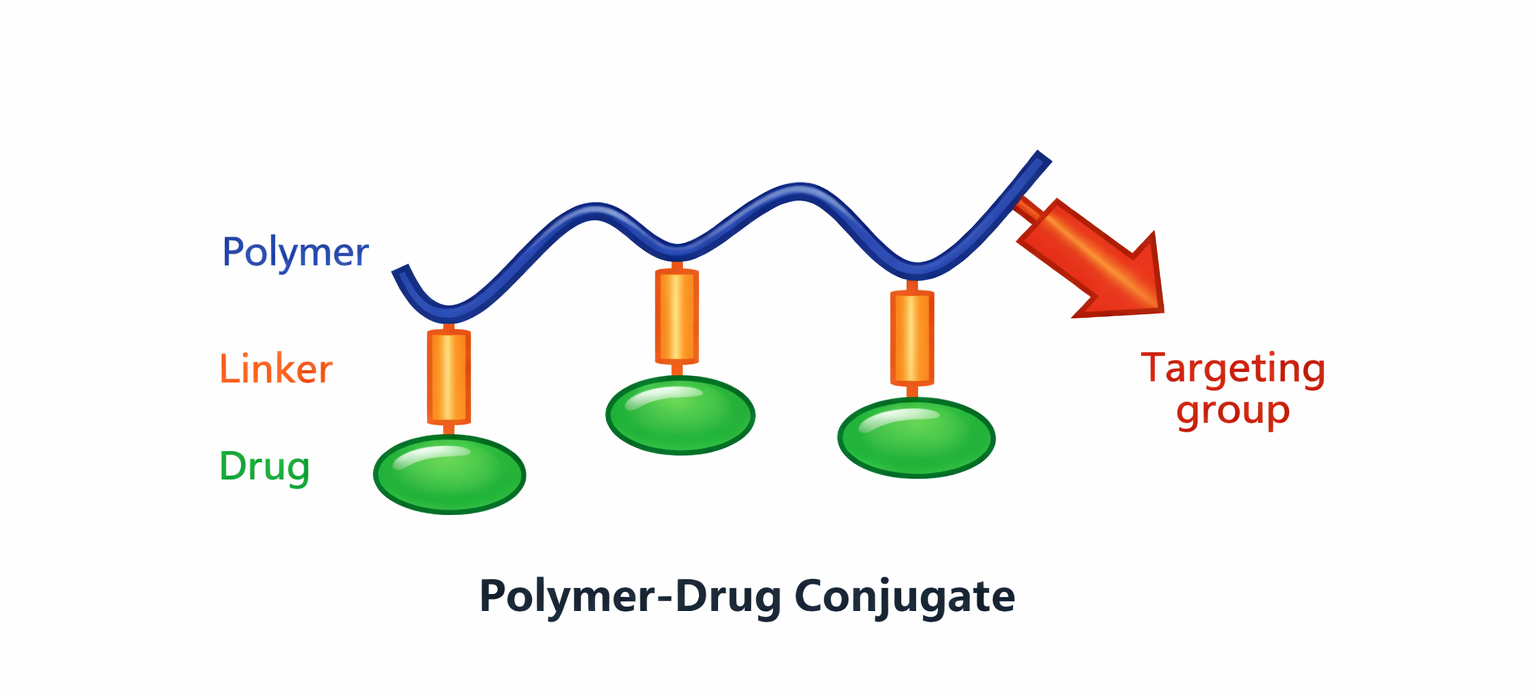
This rational design allows each component to be independently optimized while functioning as an integrated system.
1.1 Polymer backbone
The polymer backbone acts as the pharmacokinetic regulator of the conjugate. By increasing the hydrodynamic size of the drug, it reduces rapid renal clearance and extends systemic circulation time. At the same time, the chemical nature of the polymer determines key properties such as:
- Aqueous solubility of poorly soluble drugs
- Biocompatibility and biodegradability, influencing long-term safety
- Biodistribution and tissue accumulation, including passive targeting effects
- Interaction with biological barriers (e.g. plasma proteins, immune system)
Polymers such as poly(glutamic acid), HPMA copolymers, or polysarcosine provide a balance between stability in circulation and controlled biodegradation once their therapeutic role is fulfilled.
1.2 Linker chemistry
The linker is the functional switch of a PDC. It connects the drug to the polymer and dictates when, where, and how the active payload is released. Linkers can be designed to respond to specific biological cues, including:
- pH-sensitive linkers, cleaved in acidic environments such as tumors or endosomes
- Enzyme-cleavable linkers, degraded by proteases overexpressed at the target site
- Redox-sensitive linkers, responding to intracellular reducing conditions
By carefully selecting the linker chemistry, developers can fine-tune the therapeutic window, minimize off-target toxicity, and achieve sustained or site-specific drug release.
1.3 Therapeutic payload
The payload represents the active pharmacological agent and can include a wide range of modalities:
- Small-molecule drugs, such as chemotherapeutics or anti-inflammatory agents
- Peptides and proteins, benefiting from improved stability and reduced degradation
- Nucleic acids (siRNA, ASOs, emerging mRNA strategies), where conjugation can enhance delivery and bioavailability
Importantly, covalent conjugation ensures that the payload remains associated with the polymer until release is triggered, avoiding premature leakage often observed in encapsulation-based systems.
From administration to controlled release
Once administered, PDCs circulate as stable macromolecular entities. Their increased hydrodynamic size and tailored surface properties reduce rapid clearance and non-specific uptake. Drug release typically occurs at the target site, where local physiological conditions trigger linker cleavage, liberating the active drug in a controlled and predictable manner.
This combination of prolonged circulation, controlled activation, and reduced systemic exposure is what makes polymer–drug conjugates such powerful tools in modern drug delivery.
2.Polymers Commonly Used in Polymer-Drug conjugates (PDCs)
The choice of polymer is a defining factor in the performance, safety, and translational potential of polymer–drug conjugates. Beyond simply acting as a carrier, the polymer backbone governs pharmacokinetics, biodegradability, immunological profile, and conjugation versatility.
2.1 Synthetic polymers
PEG (Polyethylene glycol)
Polyethylene glycol has historically been the gold standard in polymer–drug conjugation. Its hydrophilicity, flexibility, and ability to shield drugs from immune recognition made PEGylation a cornerstone of early PDC and protein–polymer conjugate development.
However, long-term clinical use has revealed important limitations:
- Non-biodegradability, leading to potential accumulation
- Anti-PEG antibodies, increasingly reported in patients
- Reduced efficacy upon repeated dosing due to accelerated blood clearance (ABC effect)
Despite these limitations, PEG and PEG-derived conjugates remain widely used in clinical development, with well-established GMP manufacturing routes and regulatory familiarity.
These drawbacks have catalyzed the development of PEG alternatives, now considered essential for next-generation conjugates.
Polysarcosine (PSar): a next-generation PEG alternative
Polysarcosine, a polypeptoid , has emerged as one of the most promising PEG alternatives in the industry that also can be used in PDCs. Its key advantages include:
- Excellent water solubility and stealth behavior comparable to PEG
- Low immunogenicity and minimal protein adsorption
- Peptide-like biodegradability, reducing long-term accumulation risks
- Precise control over molecular weight and architecture
PSar can be GMP synthesized by Curapath with tight control over molecular weight and dispersity , making it suitable for both early development and clinical-stage conjugates.
From a manufacturing and regulatory perspective, PSar offers a compelling balance between synthetic control and biological compatibility, making it highly attractive for conjugation strategies involving small molecules, peptides, or biologics.
Poly(2-oxazoline)s (POx)
Poly(2-oxazoline)s represent another versatile class of PEG alternatives. Their main strengths lie in their exceptional tunability:
- Adjustable hydrophilicity and degradation rates
- Multiple side-chain functionalities for conjugation
- Favorable pharmacokinetic profiles in preclinical models
POx polymers can be produced reproducibly and adapted to GMP processes, enabling smooth translation from R&D to clinical manufacturing.
POx-based conjugates have demonstrated strong potential in oncology and inflammatory indications, particularly where fine control over polymer architecture is required.
Poly(glutamic acid) (PGA)
Poly(glutamic acid) occupies a unique position at the intersection of synthetic polymers and biomacromolecules. As an anionic polypeptide, PGA offers:
- Intrinsic biodegradability via enzymatic pathways
- High aqueous solubility and low toxicity
- Multiple carboxylate side chains enabling high drug-loading densities
- Reduced non-specific interactions due to its anionic nature
PGA and its derivatives can be manufactured under GMP conditions and functionalized using well-established conjugation chemistries, supporting clinical and commercial development.
PGA has been extensively explored in anticancer PDCs, where it enables controlled drug release, prolonged circulation, and reduced systemic toxicity. Its chemical versatility and biological familiarity make it a cornerstone polymer for advanced conjugation platforms.
2.2 Biodegradable and biocompatible polymers
HPMA copolymers
HPMA-based copolymers are among the most clinically validated polymer platforms for drug conjugation. Their success stems from:
- Proven safety and biocompatibility
- Flexible incorporation of cleavable linkers
- Predictable pharmacokinetic behavior
HPMA copolymers benefit from established synthetic routes and can be supplied at GMP grade, facilitating late-stage development.
PLGA-based conjugates
PLGA is widely used in drug delivery due to its biodegradability and regulatory familiarity. In PDCs, PLGA-based systems offer:
- Controlled degradation via ester hydrolysis
- Tunable release profiles through polymer composition
PLGA is commercially available at GMP grade and remains a robust option for specific conjugation strategies, particularly when degradation-driven release is desired.
However, PLGA conjugates often exhibit more complex and less predictable release behavior, making them better suited for specific applications rather than universal PDC platforms.
Polypeptides and polypeptoids
Polypeptides and polypeptoids represent a biomimetic evolution of synthetic polymers. Their amino acid–derived backbones allow:
- Enzymatic degradability and metabolic compatibility
- Precise sequence and molecular weight control
- Multiple functional handles for site-specific conjugation
These platforms can be custom-designed and manufactured under GMP conditions, enabling highly tailored polymer–drug conjugates aligned with specific therapeutic needs.
Polypeptoids, such as polysarcosine, further reduce hydrogen bonding and secondary structure formation, resulting in enhanced solubility and stealth properties.
2.3 Emerging polymer platforms
As the field moves toward precision drug delivery, several emerging polymer technologies are reshaping PDC design:
- Clickable polymers, enabling site-specific and reproducible conjugation
These chemistries are compatible with scalable and GMP-compliant manufacturing. - Stimuli-responsive polymers (pH, redox, enzymatic), enabling on-demand drug release
Such systems can be translated into GMP processes with appropriate linker and polymer selection. - Dendritic and hyperbranched polymers, offering high drug-loading capacity and multivalency
Advanced architectures can be developed and scaled with controlled synthesis strategies.
2.4 GMP-ready polymers for polymer–drug conjugates (PDCs)
GMP-ready polymer platforms for polymer–drug conjugates include PEG alternatives (polysarcosine, poly(2-oxazoline)s), poly(glutamic acid) (PGA) and PGA derivatives, as well as synthetic polypeptides and polypeptoids. These polymers are suitable for GMP polymer–drug conjugation, enabling scalable manufacturing, consistent polymer quality, and direct translation from R&D to clinical development.
At Curapath, these GMP-ready polymer platforms are part of our in-house capabilities and portfolio, supporting PDC development from early design to clinical supply.
| Polymer platform | Polymer type | Key advantages in PDCs | GMP readiness / translational relevance |
|---|---|---|---|
| PEG | Synthetic, neutral | Stealth properties, improved solubility, extended circulation | Established GMP routes, clinically validated but limited by immunogenicity |
| Polysarcosine (PSar) | Polypeptoid (PEG alternative) | Low immunogenicity, excellent solubility, peptide-like biodegradability | GMP-ready PEG alternative suitable for clinical translation |
| Poly(2-oxazoline)s (POx) | Synthetic (PEG alternative) | High tunability, controlled architecture, favorable PK profiles | Reproducible synthesis compatible with GMP manufacturing |
| Poly(glutamic acid) (PGA) | Anionic polypeptide | Biodegradable, high drug loading, reduced non-specific interactions | GMP-ready platform widely explored in clinical-stage PDCs |
| HPMA copolymers | Synthetic, hydrophilic | Proven safety, flexible linker chemistry | Clinically validated and GMP-compatible |
| PLGA-based conjugates | Biodegradable polyester | Controlled degradation, regulatory familiarity | Commercial GMP availability, release can be complex |
| Polypeptides / polypeptoids | Biomimetic polymers | Enzymatic degradability, sequence control, versatile conjugation | Customizable and scalable under GMP conditions |
3.Linker chemistry: enabling controlled and site-specific drug release
In polymer–drug conjugates, the linker is often the most critical design element, as it determines when, where, and how the active drug is released from the polymer backbone. While the polymer governs circulation and biodistribution, linker chemistry ultimately defines the therapeutic window and safety profile of the conjugate.
Linkers can be broadly classified into non-cleavable and cleavable systems. Non-cleavable linkers rely on polymer degradation or intracellular processing to liberate the drug, offering high stability during circulation. In contrast, cleavable linkers are designed to respond to specific biological stimuli, enabling controlled and site-selective drug release.
Common cleavable linker strategies include:
- pH-sensitive linkers, which exploit the acidic microenvironment of tumors or endosomal compartments
- Enzyme-cleavable linkers, degraded by proteases overexpressed at the target site
- Redox-sensitive linkers, responsive to intracellular reducing conditions
The choice of linker must be carefully matched to the polymer backbone. Platforms such as anionic polyelectrolytes (e.g. poly(glutamic acid)), PEG alternatives, and polypeptides or polypeptoids are particularly well suited for cleavable linker strategies, as they provide accessible functional groups and predictable degradation pathways.
Ultimately, rational linker design enables polymer–drug conjugates to remain stable in circulation while releasing the therapeutic payload in a controlled, localized, and reproducible manner, maximizing efficacy while minimizing systemic toxicity.
4.Clinical success stories and future perspectives for PDCs
4.1 From concept to clinic: selected success stories
Polymer–drug conjugates have successfully progressed from academic concepts to clinical-stage and approved therapies, particularly in oncology. One of the most cited examples is poly(glutamic acid)–based conjugates, such as paclitaxel–PGA formulations, which demonstrated improved solubility, prolonged circulation, and reduced systemic toxicity compared to free paclitaxel. These systems validated the potential of anionic polypeptide backbones to safely deliver potent cytotoxic drugs.
Similarly, HPMA-based polymer–drug conjugates have reached advanced clinical evaluation, establishing key design principles for linker selection, drug loading, and pharmacokinetic control that continue to inform next-generation platforms.
Beyond oncology, polymer conjugation strategies are increasingly explored for peptides, proteins, and emerging nucleic acid therapeutics, where polymers improve stability, bioavailability, and tolerability.
4.2 Key challenges in translation
Despite these successes, several challenges remain critical for broader clinical adoption:
- Precise control over conjugation chemistry, ensuring batch-to-batch reproducibility
- Balancing stability and release, particularly for cleavable linker systems
- Polymer immunogenicity and long-term safety, driving the shift toward PEG alternatives
- Scalability and GMP manufacturing, essential for late-stage and commercial development
Addressing these challenges requires polymers and conjugation strategies that are not only scientifically robust, but also manufacturable, scalable, and regulatorily aligned.
4.3 where PDCs are heading
The future of polymer–drug conjugates lies in biodegradable, modular, and precision-designed platforms. Advances in PEG alternatives, polypeptides and polypeptoids, anionic polyelectrolytes such as PGA, and smart linker chemistries are enabling PDCs that combine clinical performance with translational readiness.
As these technologies mature, PDCs are expected to play an increasingly central role in targeted therapies, combination treatments, and next-generation biologics, bridging the gap between molecular precision and real-world clinical impact.
At Curapath, our expertise in polymer–drug conjugates includes GMP-ready PEG alternatives, poly(glutamic acid) (PGA) and PGA derivatives, as well as polypeptide- and polypeptoid-based platforms designed for clinical translation.
-1.jpg)
.png)
.png)