.png)

Active targeting has emerged as one of the most promising strategies to unlock extrahepatic delivery of nanoparticles, from T cells to lung epithelium to the brain. The ambition is simple: get the right therapy to the right tissue, every time.
Yet most conversations stop at ligand selection. Which antibody? Which peptide? Which aptamer? Far less attention goes to a more fundamental question: how the ligand is actually attached to the nanoparticle surface. That distinction matters more than it might seem: targeting performance is not defined by ligand choice alone; stability, ligand density and orientation, and ultimately in vivo behavior are equally shaped by the surface chemistry underneath.
1. What is Active Targeting?
Active targeting refers to the strategy of functionalizing nanoparticles with specific ligands that enable selective interaction with target cells through receptor-mediated mechanisms. These ligands can be antibodies, peptides or small molecules and are designed to recognize and bind to surface markers expressed on specific cell types.
By directing nanoparticles toward their intended biological destination, active targeting adds an extra layer of specificity beyond passive mechanisms such as the EPR effect and offers a route to overcome the persistent challenge of extrahepatic delivery.
This approach is gaining momentum as the field moves beyond liver-targeted delivery. For many emerging applications, reaching extrahepatic tissues remains a key challenge. Active targeting offers a pathway to address this limitation by improving the precision of nanoparticle–cell interactions.
|
Passive Targeting |
Active Targeting |
|
|
Mechanism |
Relies on physiological effects (e.g. EPR effect) |
Ligand–receptor interactions |
|
Specificity |
Low to moderate |
High (cell-type specific) |
|
Target tissues |
Primarily liver and tumors |
Extrahepatic tissues (T cells, lung, brain, etc.) |
|
Control over delivery |
Limited |
Tunable via ligand selection and density |
|
Cellular uptake |
Indirect |
Enhanced via receptor-mediated endocytosis |
|
Clinical limitations |
Off-target accumulation, variability |
Dependent on efficient surface functionalization |
While active targeting clearly offers advantages over passive approaches, its success depends on more than ligand selection alone. As we will explore, the way these ligands are introduced onto the nanoparticle surface plays a critical role in defining targeting performance.
2.Active Targeting in Next-Generation Therapies
As therapeutic modalities move from systemic approaches to precise interventions, efficacy is no longer defined by organ-level delivery alone, but by the ability to engage specific cell populations within complex tissues.
This is particularly relevant for in vivo CAR‑T therapies, where nanoparticles must reliably and selectively interact with immune cells to enable efficient genetic modification. Similar challenges arise in RNA‑based therapies targeting the lung or central nervous system, where broad biodistribution often dilutes therapeutic effect and increases the risk of off-target activity.
In oncology, the role of targeted nanoparticles lies not only in tumor accumulation, but also in the ability to discriminate between malignant cells and healthy tissue within the tumor microenvironment. Without precise control over nanoparticle–cell interactions, this level of selectivity remains difficult to achieve.
Across these applications, active targeting underpins more effective and predictable therapies by steering nanoparticles toward defined cell populations instead of relying on broad biodistribution.
3.Enabling Active Targeting: The Role of Advanced Conjugation Technologies
in collaboration with Cristal Therapeutics
Surface functionalization: the real enabler of active targeting
While ligand selection often gets most of the attention in targeted nanoparticle design, the success of active targeting ultimately depends on how ligands are presented on the nanoparticle surface. This surface functionalization step controls parameters such as ligand density, orientation, and linkage stability, which together shape in vivo targeting performance.
Key parameters affected include:
|
Parameter |
Description |
Impact on Targeting Performance |
|
Ligand density |
Number of ligands per nanoparticle surface |
Controls binding efficiency and cellular uptake; too low reduces targeting, too high may cause steric hindrance |
|
Ligand orientation |
Spatial presentation of the ligand |
Determines accessibility to receptors and binding affinity |
|
Conjugation efficiency |
Fraction of ligands successfully attached |
Directly affects reproducibility and targeting consistency |
|
Surface stability |
Stability of the ligand–nanoparticle linkage |
Impacts in vivo performance and ligand retention |
|
Nanoparticle integrity |
Preservation of size, PDI, and structure |
Ensures predictable biodistribution and delivery |
|
Hydrophilicity of the system |
Compatibility with aqueous environments |
Reduces aggregation and preserves nanoparticle functionality |
In addition, the surface chemistry must remain compatible with the physicochemical properties of the nanoparticle, preserving critical attributes such as size, polydispersity, and encapsulation efficiency, making surface functionalization a central design parameter rather than a late-stage add‑on.
What makes CliCr® different
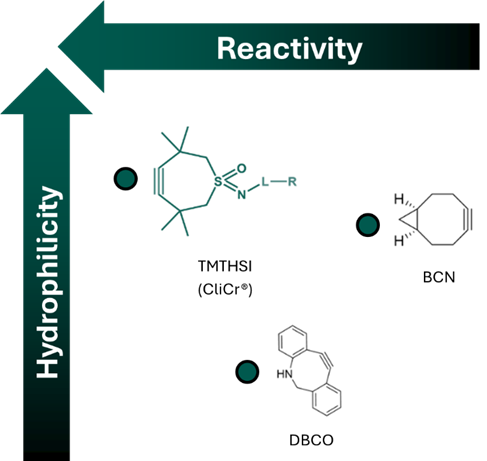
CliCr® is based on TMTHSI, a proprietary strained alkyne engineered for copper-free click chemistry. Unlike conventional click reagents that are typically hydrophobic and slow-reacting, TMTHSI combines high reactivity with strong water compatibility, making it particularly suited to nanoparticle functionalization.
Key advantages:
- Fast kinetics and high yields, even with labile biomolecules, enabling shorter reaction times.
- Improved hydrophilicity, enhancing compatibility with aqueous nanoparticle systems and reducing unwanted interactions.
- Small molecular footprint, minimizing steric hindrance and preserving ligand functionality.
- Stable, irreversible conjugation, yielding robust bioconjugates suitable for in vivo use and long-term storage
Performance vs conventional click chemistries
Compared to widely used copper-free reagents such as DBCO and BCN, TMTHSI‑based CliCr® reagents exhibit significantly higher reaction rates and better water solubility, as demonstrated in head‑to‑head comparative studies.
At the formulation level, this translates into:
- Tunable ligand density on the nanoparticle surface, enabling application‑specific optimization.
- Reduced processing time, limiting exposure to destabilizing conditions, costly purification steps, and inefficient use of valuable ligands.
- Maintained critical quality attributes of the native nanoparticle, including particle size, polydispersity, and encapsulation efficiency, without introducing additional hydrophobic stress to the system.
Crucially, better chemistry directly influences biological performance. Precise control over surface architecture leads to targeted nanoparticles with predictable in vivo behavior.
One example illustrates this well. DBCO moieties, due to their inherent hydrophobicity, have been shown to promote aggregation of surface‑functionalized proteins, an effect that is recognized by the complement system, with higher degrees of labeling (DOL) correlating with increased complement activation in vivo. The implications are significant: even a well‑chosen ligand, attached via the wrong chemistry, can promote aggregation and complement activation in vivo, undermining therapeutic performance.
This is precisely where the hydrophilicity of CliCr® becomes clinically relevant. By avoiding the hydrophobic character associated with conventional click reagents, CliCr® mitigates DBCO‑like aggregation and complement activation across degrees of labeling, translating into improved formulation robustness, a more favorable safety profile, and more predictable in vivo behaviour.
Engineering the right conjugation chemistry is not optional. It is what separates a targeted nanoparticle that works from one that merely looks good on paper.
4. From Conjugation Chemistry to Targeted LNP Formulation
While conjugation chemistry is a critical enabler of active targeting, its true value becomes evident when integrated into the nanoparticle formulation workflow.
In practice, targeted LNPs (tLNPs) can be generated through a modular approach, where surface functionalization is incorporated either during or after nanoparticle formation. One effective strategy involves the use of pre‑functionalized shielding lipids, such as PSar‑based lipids already equipped with reactive groups like CliCr®. These components can be directly incorporated during LNP formulation, ensuring a controlled and reproducible presentation of functional handles on the nanoparticle surface.
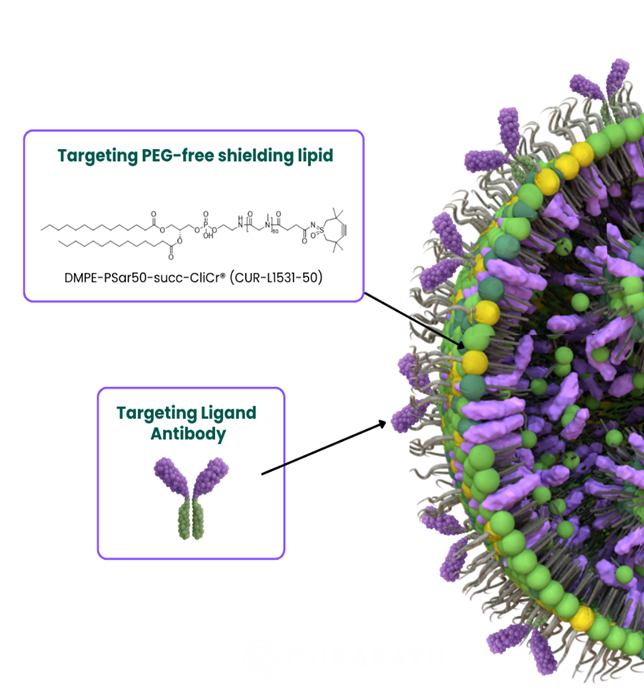
Once the LNPs are formed, targeting ligands, such as antibodies, peptides, or small molecules, can be conjugated through efficient click chemistry reactions under mild conditions. This enables flexible and scalable functionalization without compromising nanoparticle integrity.
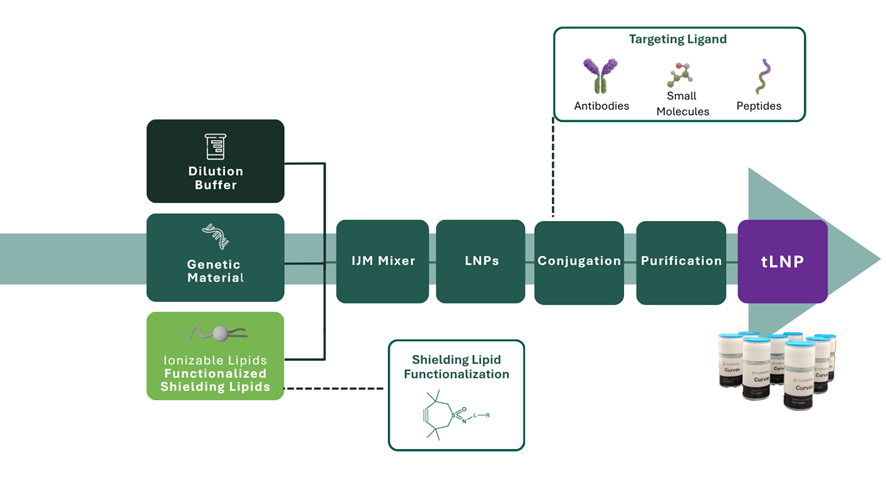
As illustrated in the formulation workflow, LNPs are first generated through standard processes (e.g. microfluidic mixing), followed by a dedicated conjugation step and subsequent purification to obtain the final targeted LNP (tLNP).
This modular strategy offers significant advantages, enabling plug‑and‑play exchange of targeting ligands while retaining control over ligand density and preserving key physicochemical properties of the LNP, and thus supporting selectivity, scalability, and translational potential.
Active targeting in LNPs sits at the intersection of surface chemistry and therapeutic design.
From ligand selection to conjugation and final nanoparticle formulation, each step plays a critical role in defining targeting efficiency, specificity, and overall biological performance. As next-generation therapies continue to evolve, the ability to engineer nanoparticle surfaces in a controlled, scalable, and reproducible way will be essential.
Ultimately, enabling active targeting is not just about adding a ligand , it is about mastering the chemistry that governs how nanoparticles interact with biology.
If you're developing targeted RNA or gene therapy programs and need support with LNP formulation, surface functionalization, or GMP manufacturing, having the right partner can make all the difference.